The products discussed Here were independently chosen by our editors. GameSpot may get a share of the revenue if you buy anything featured on our site.
We put Intel's spick-and-span leading quad-core Kaby Lake Central processing unit through its paces with 18 benchmarks.
Intel's Kaby Lake micro-computer architecture represents a new move for the company. It breaks away from Intel's farseeing-standing "ticktock-tock" release cadence. A "tick" has traditionally delineated a CPU die shrink, which we more often than not recently got with Broadwell in early 2022. A "tock" pictured new architecture, which we got in late 2022 with Skylake. With this logic, you would expect Intel's 7th generation Kaby Lake CPUs to be a die shrink, but Intel says that we aren't likely to get another one until the end of 2022. This way Kaby Lake represents a new optimization stage for Intel. Does the company make enough improvements to apologise an upgrade? Let's put the company's new leading 7700K quad-core Central processor through its paces to get out.
Like Skylake before it, Kaby Lake is built on a 14nm production process, but Intel asserts that information technology has made low-level-the-hood improvements to allow the computer architecture to reach high time speeds, and is thus calling the litigate "14nm+."
Kaby Lake represents a new optimisation phase for Intel
The 7700K is the leading Kaby Lake SKU and it has a outflow design point (TDP) of 91 watts. Because it is a K SKU, which substance it's overclockable, Intel does not include a ice chest with the chip. The keep company figures that about populate who purchase inebriated-end overclockable CPUs will slam on higher-acting aftermarket coolers.
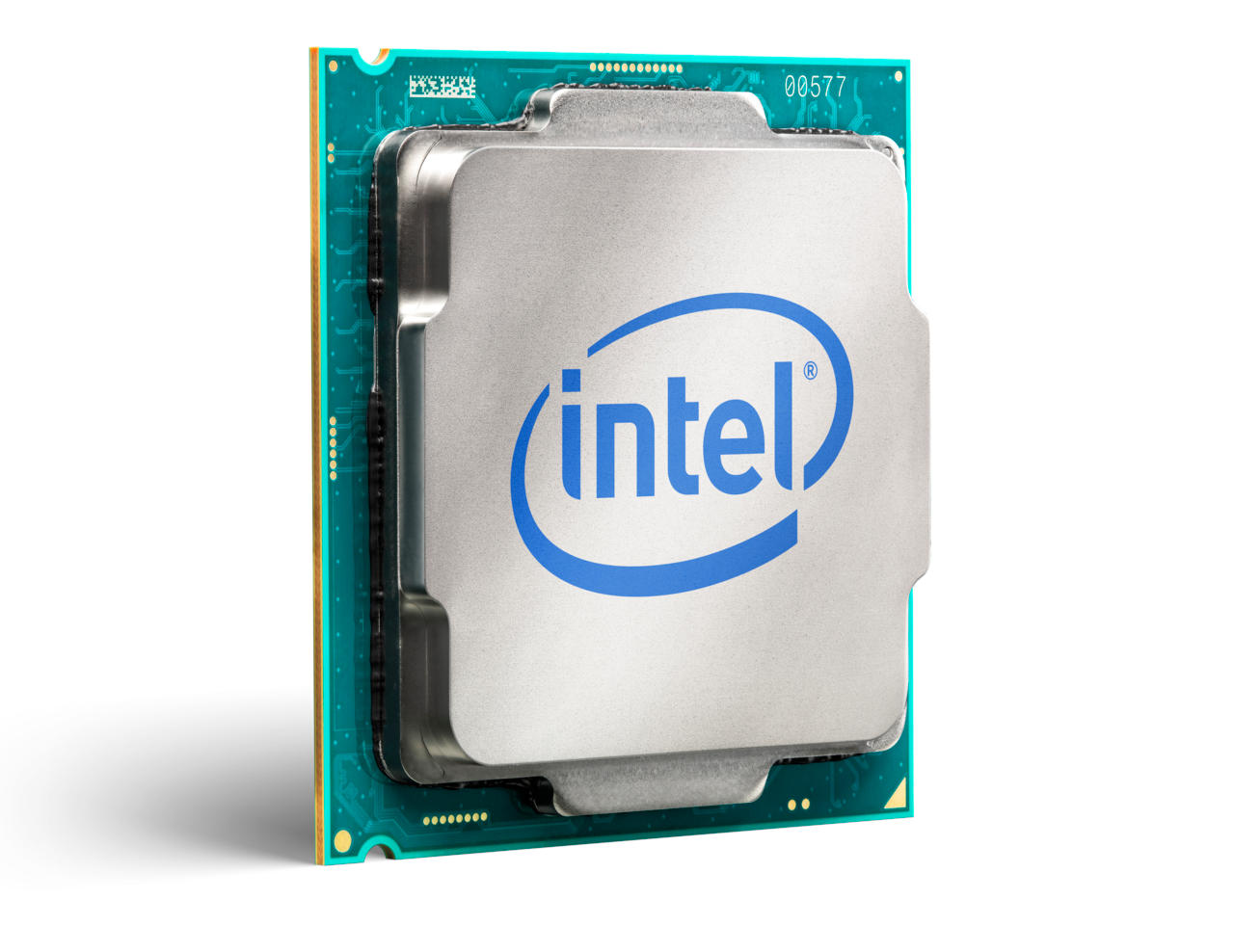
Kaby Lake CPUs use the aforementioned socket as their honest-to-goodness Skylake equivalents (LGA 1151), and you can habituate the like Z170 motherboards with Intel's sunrise CPUs, as long as you update their BIOS. The companionship has too created a new Z270 chipset for Kaby Lake. These 200-series motherboards will support Intel's upcoming Optane memory. We still don't know a lot about Optane, but Intel has asserted that its Optane is adequate to a 1,000 times as fast Eastern Samoa conventional NAND memory.
While the 7700K offers 16 PCIe 3.0 lanes like the 6700K before information technology, which is sufficient to effectively powerfulness two artwork card game, Z270 motherboards will also offer up to 24 PCIe 3.0 lanes, which is four more than Z170 mobos that debuted with Skylake. This leave grant motherboard manufacturers to append more support for features like additional M.2 NVMe ports.
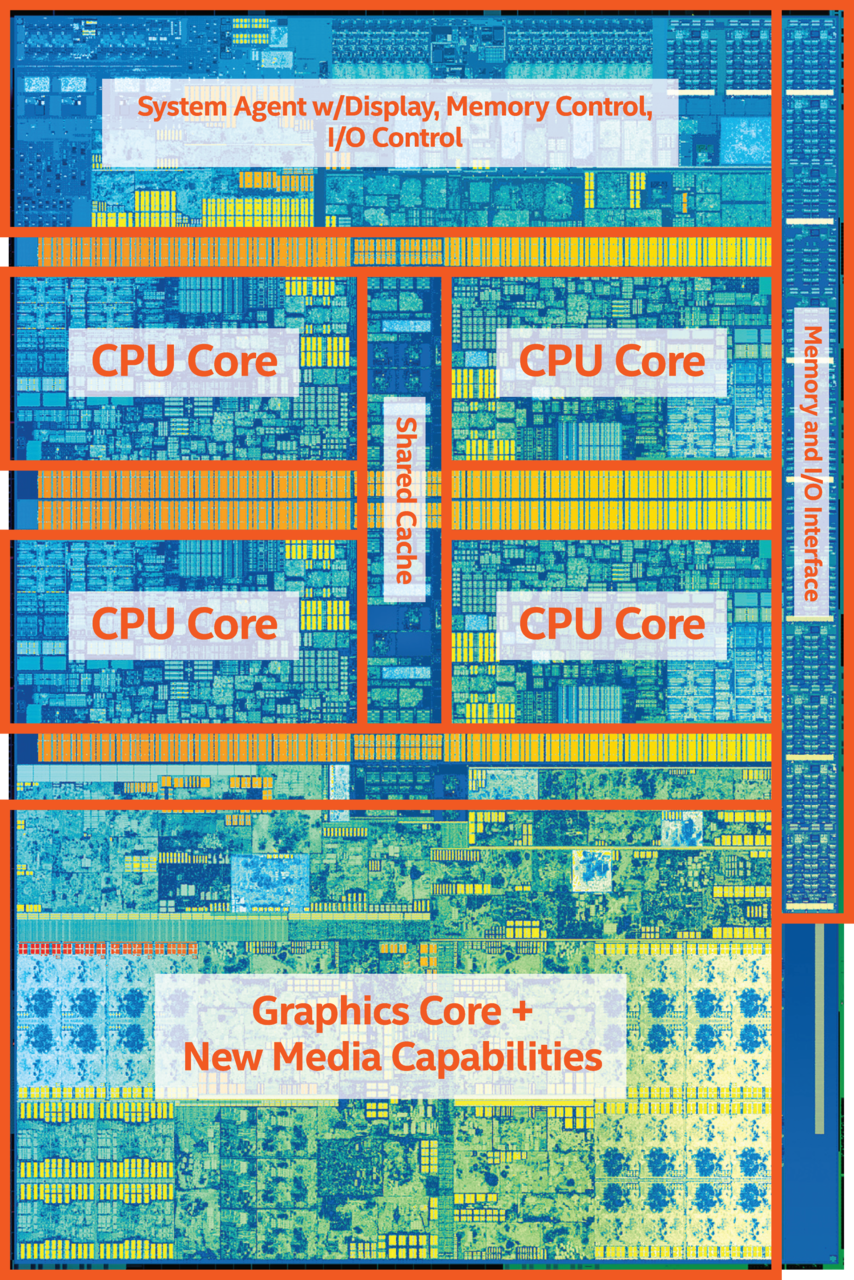
The 7700K is essentially a souped-prepared version of the 6700K. Some processors have four cores and eight threads with 8MB of SmartCache memory. Their TDPs are too the same. The 7700K's main advantage is its higher clock speed. The Kaby Lake CPU carries a 4.2GHz substructure relative frequency and a 4.5GHz advance relative frequency, which is notably higher than the 6700K's respective 4.0GHz and 4.2GHZ speeds.
The 7700K is basically a souped-up reading of the 6700K
The Kaby Lake K Family
| Central processing unit | Cores/Threads | Intel Smart Lay away | Base Relative frequency | Max Turbo Boost | TDP | Price |
| Core i7-7700K | 4/8 | 8MB | 4.2 GHz | 4.5 GHz | 91W | $339 |
| Pith i5-7600K | 4/4 | 6MB | 3.8 GHz | 4.2 GHz | 91W | $242 |
| Core i3-7350K | 2/4 | 4MB | 4.2 GHz | NA | 60W | $168 |
Intel is releasing a banging 16 Kaby Lake desktop CPUs. We've highlighted the three overclockable SKUs in the chart above. All of Intel's Kaby Lake processors here will support 2400MHz DDR4 or 1600MHz DDR3L RAM in dual-channel configuration.
Examination Methodological analysis
To put the 7700K through its paces, we'rhenium testing it against its predecessor, the 6700K. To reach testing parity, we used the same PC for both chips, which is a rig equipped with Gigabyte's Z170X-Gaming 7 motherboard with 16GB of DDR4 RAM clocked at 2133MHz in dual-channel mode coupled with NZXT's Kraken X61 ice chest and a GeForce GTX 980. Consummate Microcomputer tech specs are in the chart below.
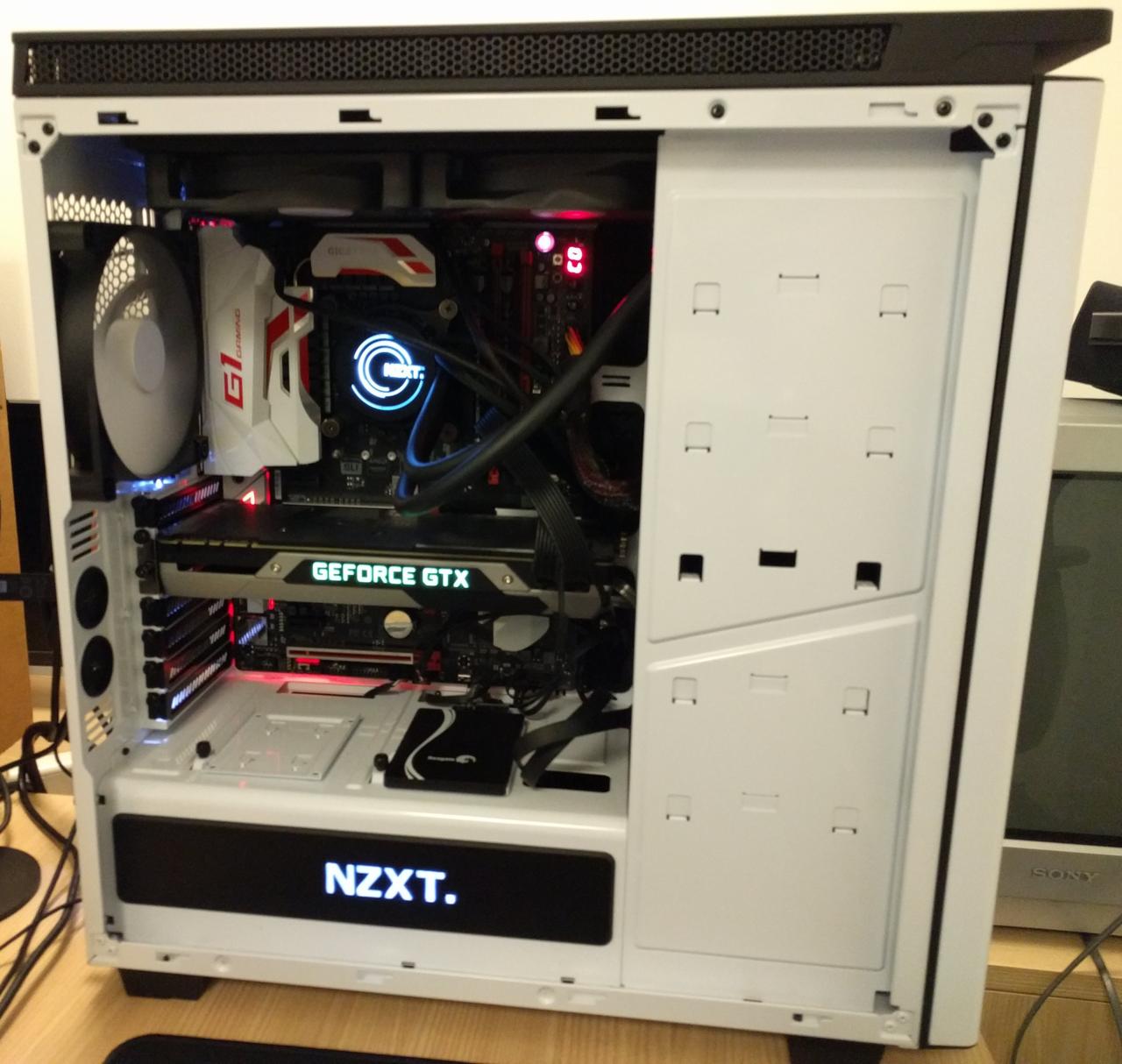
| Motherboard | Gigabyte GA-170X-Play 7 |
| RAM | Corsair Vengeance 2133MHz |
| GPU | GeForce GTX 980 |
| Computer storage | Seagate 600 Series 240GB |
| Cooler | NZXT Kraken X61 |
| Incase | NZXT H440 |
| OS | Windows 10 |
| PSU | NZXT 1200W |
Benchmarks
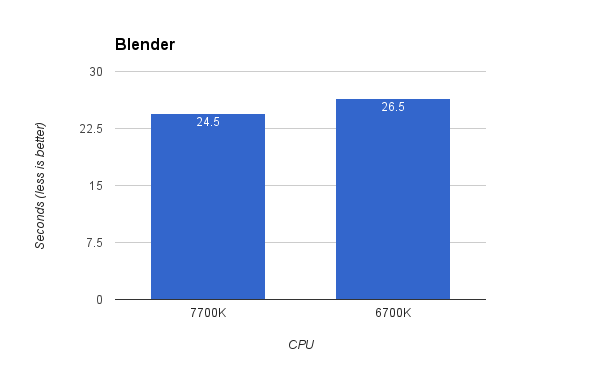
Blender is an open-source 3D art and animation program. The program effectively utilizes multi-core CPUs. We ran a short benchmark that rendered a 3D model of a flying squirrel. With its seven percent quicker boost clock, the 7700K was able-bodied to complete the benchmark eight percent faster than the 6700K.
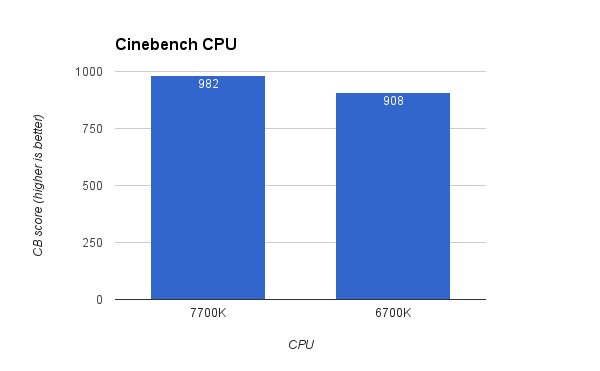
Cinebench is some other 3D animation bench mark that really takes advantage of cores. Like Blender, the 7700K was able to perform eighter percent better than the 6700K.
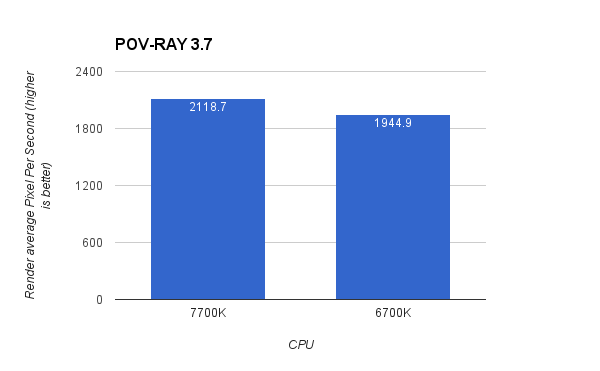
The Persistence of Imaginativeness Raytracer (POV-RAY) is a 3D ray trace program. The application also has a inherent benchmark that really pushes multi-core processors. The 7700K performed nine percentage better than the 6700K present.

POV-Shaft of light also has a bench mark that stresses single-core performance, which is useful considering many games and applications still only use unrivaled nucleus. The 7700K outperformed the 6700K by eight percentage present.

GeekBench 3.0 is a synthetic benchmark that provides a score. In its multi-core test, the 7700K scored pentad percent better than the 6700K.

GeekBench 3.0's various-core test also yielded a five percent win for the 7700K.
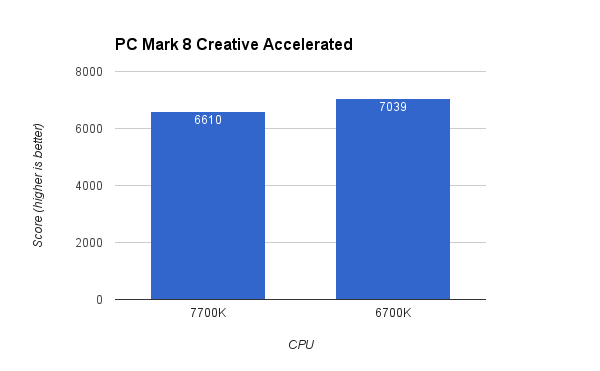
PCMark 8 is other a posteriori benchmark, but IT aims to imitate real-world tasks that include web browsing, Bible processing, video conferencing, and more. It also leverages our GPU. While this takes both accentuate off the CPU, it's Sir Thomas More mood of a real-world scenario. Out of the blue, the 6700K beat the 7700K by six percent here. We ran the test twice and got the same result. It's the only if benchmark in our suite of tests where the Skylake CPU beats the Kaby Lake central processing unit.
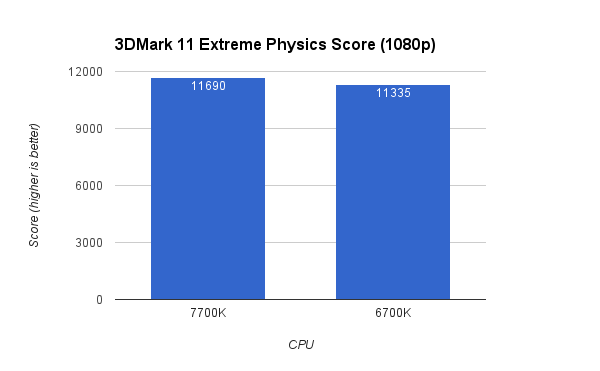
3DMark 11 is predominantly a GPU benchmark, just it does generate a physics score, which is more Central processing unit-rolled. Running the run on its Intense 1080p preset, the 7700K performed three pct better, which represents unmatched of its more modest wins.

We also wanted to run the benchmark on its performance modality, which renders eightfold scenes at 720p. Since it's less diagrammatically difficult than its Extreme planned, it leans less on the GPU and more on the CPU. Here, the 7700K performed 22 pct better than the 6700K, which is massive.

Whereas 3DMark 11 is more of a graphics test, its sister synthetic benchmark, 3DMark Vantage, calculates physical science and Acts as a CPU test. The 7700K performs Nina from Carolina percent better than the 6700K.
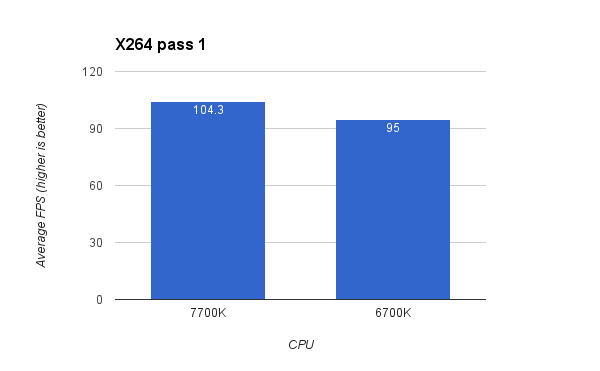
Tech ARP's x264 benchmark is a demanding video encoding test that in truth pushes multiple CPU cores. Information technology simulates encoding and converting a 1080p video clip into a high-quality x264 picture file. The benchmark offers two passes and in its first pass over, the 7700K performs 10 pct improve than the 6700K.
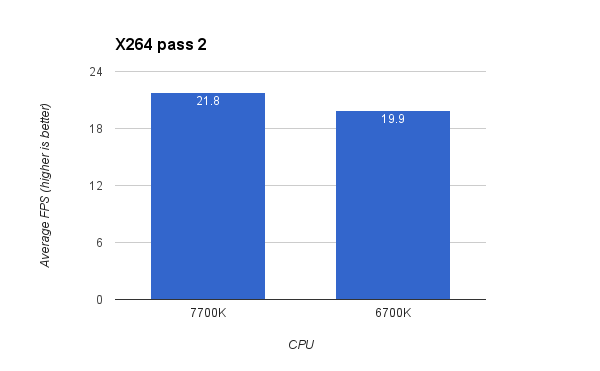
In the second pass of Tech ARP's benchmark, it as wel garnered a 10 percent best score.
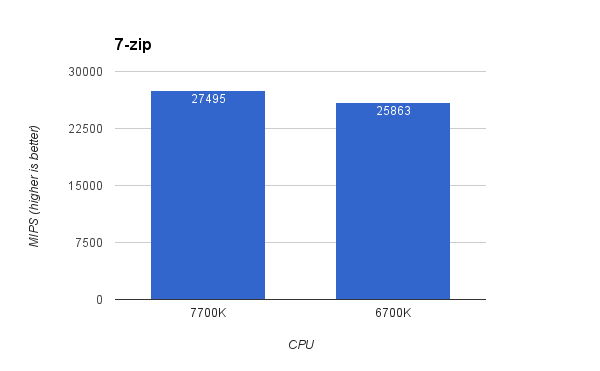
7-Naught is a popular, free instrument for compressing and decompressing files, which potty atomic number 4 very CPU-intensive tasks. The program does a great job leverage CPU cores and has a built-in bench mark. The 7700K was able-bodied to perform six percent amended than the 6700K.
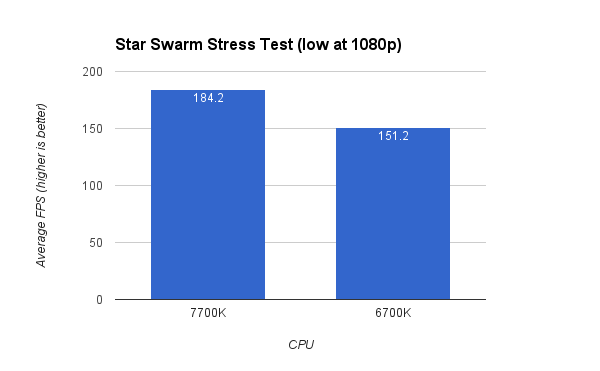
Developed by Oxide Games, makers of Ashes of the Uniqueness, the Star Swarm Punctuate Test is a real-time tech demo. With hundreds of space ships flying some the galaxy, information technology's one of those rare game tests that utilizes multi-core processors really swell. Running the benchmark along its worst settings at 1080p to leverage the CPU as far as possible, the 7700K performed 22 percent faster than the 6700K, which is huge.
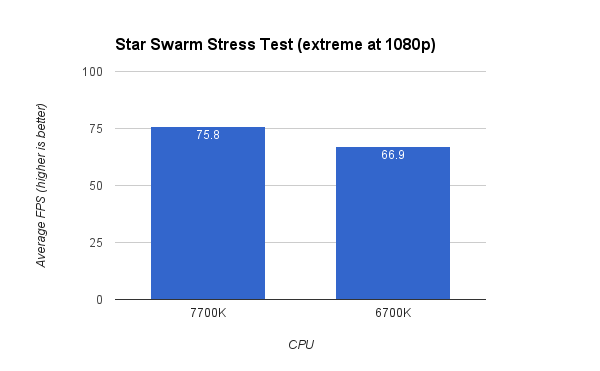
Bumping the tryout equal to its extreme preset, the 7700K's jumper cable decreased with the benchmark atilt more on the GPU, but it still kept up a highly respectable 13 percent advantage.

Irrational Games' BioShock Infinite is a first-person shooter that leverages ten-fold cores well. When we tone the graphics land to the game's low planned to purchase the CPU, the 7700K performed iv percent faster than the 6700K.
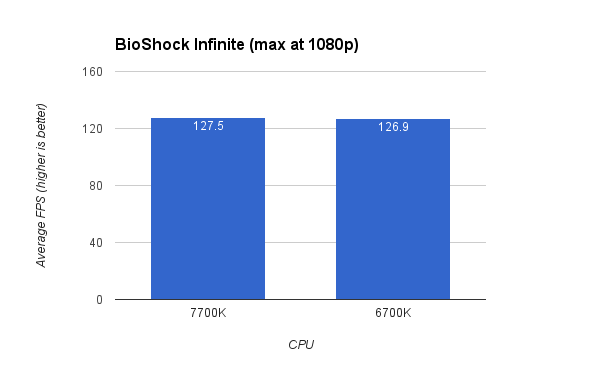
When we cranked up Infinite's graphical settings to max, which represents a more real-world scenario, both CPUs stop awake in a statistical tie with the halting leaning to a great extent on the GPU.
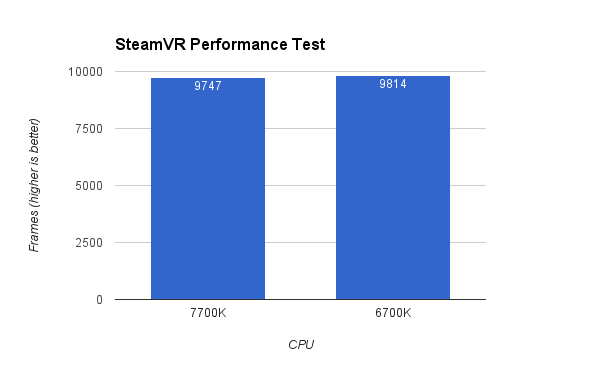
Intel is marketing the 7700K as a great chip for VR experiences. Regrettably, there aren't that many VR benchmarks. When we ran Valve's SteamVR Performance Test, which is more of a GPU try, but both CPUs ended up in a statistical tie.
Temperatures and Overclocking
Screaky clock speeds usually equate to senior high temperatures, and because the 7700K features aggressive time speeds right out of the box, heating plant becomes a legitimate concern. At idle just sitting in the OS, we measured the processor at around 29 degrees celsius. Running the CPU-intensive x264 test to commit a stress happening the chip, temperatures shot equal to some 85 degrees C, which is pretty hot. Traditionally, anything above 80 degrees C treads into uncomfortable dominio.
In terms of overclocks, your mileage May vary as every single C.P.U. overclocks otherwise (even CPUs of the same SKU), merely with our setup, we were able to push our 7700K to 4.8GHz with around 1.3 volts of power. This represents a six percent overclock, which was reflected with our six percent public presentation gain in our x264 test. That's not a huge overclock, but perhaps the bigger concern is that our temperatures chromatic to the 90s. IT even hit 100 degrees C happening more than one affair. That's really hot, especially since our NZXT Kraken X61 water cooler is quite keen.
Conclusion
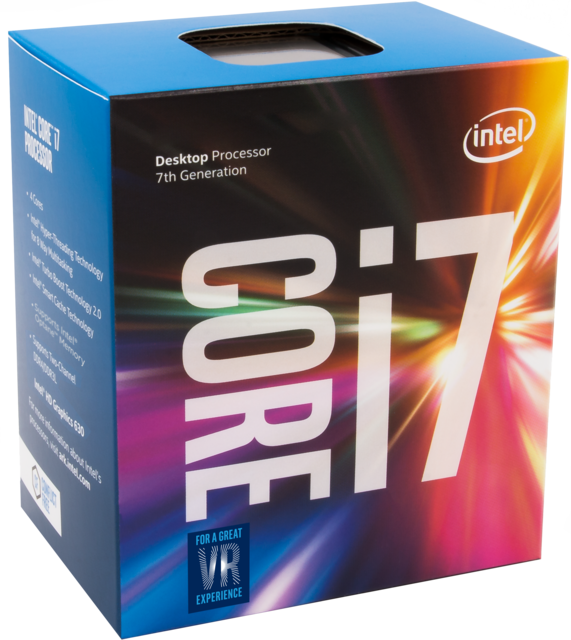
The 7700K outperforms the 6700K by 7.5 percent when you take the average of our 18 benchmarks. While that's non a mind-blowing kick upstairs, it is in line with Intel's more recent people jumps. Perhaps its biggest sin is that it gets hot, especially when you overclock information technology.
It's really not worth upgrading to if you have a 6700K. In point of fact, if you have an i7 Haswell CPU (4th contemporaries processor), it still probably International Relations and Security Network't meriting the upgrade unless you want new features so much as native NVMe, Thunderbolt 3, and DDR4 patronage.
If you're non in a rush to build a parvenu PC, information technology might be a good approximation to wait to see how AMD's Ryzen CPU pans out. The 8-core processor looks quite promising from explorative tests, and it's supposedly right around the corner.
Just if you simply can't expect to build a spic-and-span PC and want a top-of-the-line CPU, the 7700K is what you should incur. It's faster than the 6700K, and costs just about the same. It's the best consumer quad-core chip that money buttocks buy today.
Got a news baksheesh or want to contact United States directly? E-mail news@gamespot.com
Best Fan for Intel Core I7-7700k Kaby Lake
Source: https://www.gamespot.com/articles/intel-core-i7-7700k-kaby-lake-review/1100-6446489/
Post a Comment